
When designing a solar power system for an outdoor IoT device, one of the first questions is often:
“How large should the solar panel be?”
It seems like a logical place to start.
The device needs power, and the solar panel generates power. So choosing the right panel wattage feels like the beginning of the design process.
But solar panel size alone does not determine whether an outdoor device will operate reliably.
A better starting point is to understand four things:
- How much energy does the device consume each day?
- How much energy must the battery store?
- How long must the system operate without sufficient sunlight?
- How much solar energy is needed to replace the energy consumed?
This leads to a more practical design sequence:
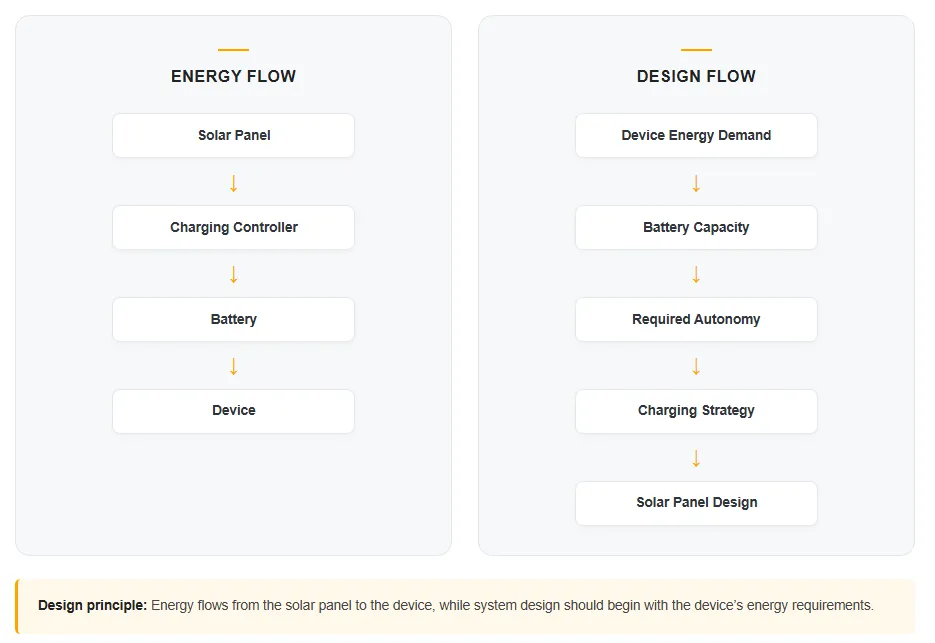
Device Energy Demand → Battery Capacity → Charging Strategy → Solar Panel Design
The solar panel should be the result of the system design—not the starting point.
Why Solar Panel Wattage Should Not Be the Starting Point
A customer may contact us with a request such as:
“We need a 5W solar panel for our outdoor monitoring device.”
But 5W alone does not tell us whether the system will operate reliably.
Before selecting the panel, we need to understand where the energy is going and how it will be stored.
For example, two devices may both use a 5W solar panel.
However, one device may consume 10Wh of energy per day while another consumes 30Wh.
They may also have different:
- Battery capacities
- Operating schedules
- Communication frequencies
- Installation locations
- Required backup times
- Available sunlight
The same solar panel can therefore perform very differently in two different systems.
Engineering Note: Solar panel wattage is only one part of the energy system. It should be selected after the device’s energy requirements and storage strategy are understood.
Understand the Energy Flow First
In most solar-powered outdoor electronics, the solar panel does not continuously power the device directly.
The energy flow typically looks like this:
Solar Panel → Charging Controller → Battery → Electronic Device
The solar panel generates energy when sunlight is available.
The battery stores part of that energy and supplies it when solar generation is insufficient.
This may happen:
- At night
- During cloudy weather
- Under temporary shading
- During low-sunlight seasons
- When the device temporarily consumes more power than the panel can provide
This is why the battery plays such an important role in outdoor system reliability.
Energy Flow vs. Design Flow
There is an important distinction between how energy moves through the system and how the system should be designed.
Step 1 — Calculate the Device’s Daily Energy Demand
Before choosing a battery or solar panel, first understand how much energy the device actually consumes.
Simply knowing the rated power of the device may not be enough.
Outdoor IoT devices often have several operating states, such as:
- Active operation
- Standby
- Sleep mode
- Sensor measurement
- GPS positioning
- Wireless transmission
- Data processing
For example, a remote sensor may spend most of the day in a low-power sleep state but consume significantly more power when transmitting data through LoRa, NB-IoT, LTE, or another wireless network.
This means we should consider the complete operating profile.
Important information may include:
- Operating voltage
- Average power consumption
- Peak current
- Standby consumption
- Operating hours
- Transmission frequency
- Duty cycle
A simplified energy calculation is:
Daily Energy Consumption (Wh/day) = Power (W) × Operating Time (h/day)
For devices with multiple operating states, the energy used in each state should be considered separately.
The important question is therefore not simply:
“How many watts does the device use?”
A more useful question is:
“How much energy does the device consume during a complete 24-hour operating cycle?”
Once daily energy demand is understood, battery and solar-panel sizing become much more meaningful.
Step 2 — Define the Battery Capacity
The solar panel generates energy.
The battery makes that energy available when the device needs it.
This difference is particularly important for outdoor electronics because solar generation and device consumption do not always happen at the same time.
A sensor may need to operate continuously for 24 hours.
Solar energy, however, is mainly available during daylight.
The battery therefore needs to support periods when:
Device Energy Demand > Available Solar Energy
Battery sizing should consider factors such as:
- Daily device energy consumption
- Battery voltage
- Battery capacity
- Usable battery capacity
- Charging and discharging efficiency
- Expected operating temperature
- Required backup time
But another factor is especially important.
Required Autonomy
Autonomy describes how long the system should continue operating when sufficient solar energy is unavailable.
Ask:
Should the device survive one night without charging?
Or:
Should it continue operating through two or three cloudy days?
For some remote monitoring applications, the requirement may be even longer.
A system designed for one night of backup requires a very different battery strategy from a system expected to survive several low-sunlight days.
This is why battery capacity should not be selected only from the device’s nominal voltage or physical space available inside the enclosure.
It should reflect the energy demand and required autonomy of the complete system.
Battery Chemistry Also Affects Solar Design
Battery capacity is not the only consideration.
Battery chemistry can also affect the charging system and therefore the solar-panel design.
Different energy-storage technologies have different voltage characteristics, charging requirements, cycle performance, and environmental considerations.
Lithium-Ion Batteries
Typical advantages include:
- High energy density
- Compact size
- Widely available battery formats
Design considerations include:
- Controlled charging requirements
- Battery protection
- Temperature considerations
LiFePO₄ Batteries
Typical advantages include:
- Long cycle life
- Good thermal stability
- Suitability for many outdoor energy-storage applications
However, LiFePO₄ batteries have different voltage and charging characteristics from conventional lithium-ion batteries.
Supercapacitor-Based Systems
Supercapacitors can be useful in certain low-power or high-cycle applications.
They provide:
- Fast charging and discharging
- Very high cycle capability
But their energy-storage characteristics are very different from batteries, so the overall energy-management strategy must also be different.
The important point is not that one energy-storage technology is always better.
It is that:
Battery chemistry influences the charging strategy, and the charging strategy influences the electrical requirements of the solar panel.
Step 3 — Define the Charging Strategy
Once the battery system is understood, the next step is to look at how solar energy will charge it.
In many systems, the connection is not simply:
Solar Panel → Battery
Instead, it is:
Solar Panel → Charging Controller → Battery
Depending on the product, the charging system may use:
- A solar charging IC
- DC-DC charging circuit
- PWM controller
- MPPT controller
- Integrated power-management board
- Customer-designed charging circuit
The charging controller may define parameters such as:
- PV input voltage range
- Maximum input voltage
- Minimum operating voltage
- Charging current
- Battery charging profile
These requirements can directly influence solar-panel voltage and cell configuration.
For this reason, when developing a custom solar module, it is useful to provide the controller model or datasheet whenever available.
Related Engineering Note: For a more detailed explanation of controller PV input range, Vmp and Voc, see our Solar Panel Voltage for Battery Charging Guide.
Step 4 — Size the Solar Panel
Only after understanding the device, battery, and charging strategy should solar-panel sizing begin.
The required solar input depends on several factors:
- Daily Device Energy Demand
- Battery Charging Requirement
- Available Solar Energy
- Charging and System Losses
- Design Margin
- Required Solar Panel Power
The objective is not simply to install the largest panel possible.
The objective is to generate enough usable energy to maintain the required system operation under the expected environmental conditions.
Important considerations include:
- Daily energy requirement
- Local solar conditions
- Installation angle
- Seasonal variation
- Shading
- Panel orientation
- Charging efficiency
- Available installation area
- Required design margin
This is particularly important for compact IoT devices where the available solar-panel area may be limited by the product enclosure.
In these applications, the design may require balancing:
Panel Area ↔ Cell Efficiency ↔ Battery Capacity ↔ Device Consumption
Why a Bigger Solar Panel Does Not Always Solve the Problem
When a solar-powered device performs poorly, one common response is:
Low System Performance → Increase Solar Panel Wattage
Sometimes this helps.
But not always.
Scenario A — The Battery Is Too Small
Imagine that the solar panel generates enough energy during the day, but the battery cannot store enough energy to operate the device throughout the night.
Installing a larger solar panel may increase daytime generation.
But if the battery remains the limiting factor, the system may still fail before sunrise.
In this situation, the problem is not simply insufficient solar wattage.
It is insufficient energy storage.
Scenario B — The System Works in Summer but Fails in Winter
A system may operate reliably during long sunny summer days but struggle when:
- Daylight hours decrease
- Weather becomes cloudier
- Installation conditions reduce solar exposure
Increasing panel size may help, but battery autonomy and seasonal solar availability should also be evaluated.
The correct solution may involve both:
Solar Generation + Energy Storage
Scenario C — The Charging Controller Is the Limitation
A larger solar panel may also be ineffective if the charging controller cannot use the additional input effectively.
The controller may have limits related to:
- Input voltage
- Input current
- Charging current
- Maximum supported power
This is why:
Bigger solar panel ≠ automatically better charging performance.
The entire power system needs to be considered together.
Example: Designing Solar Power for an Outdoor Monitoring Device
Consider a simplified customer request:
“We need a 5W solar panel for our outdoor monitoring device.”
Should we immediately recommend a 5W module?
Not yet.
We would first want to understand several parts of the system.
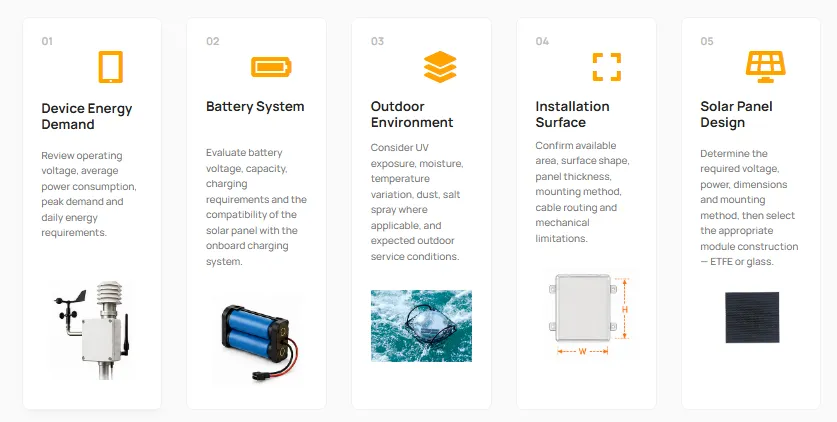
1. Device
What is the operating voltage?
How much energy does the device consume per day?
What is the peak current?
How frequently does it transmit data?
2. Battery
What battery chemistry is being used?
What is the nominal voltage?
What is the battery capacity?
3. Required Autonomy
How long should the device continue operating when solar charging is insufficient?
One night?
Two cloudy days?
Three days?
4. Charging Controller
What controller is being used?
What is the permitted PV input voltage range?
What charging current does it support?
5. Installation
How much area is available for the solar panel?
How will the module be mounted?
Will the device be installed horizontally, vertically, or at an angle?
What environmental conditions will it experience?
Only after these questions are answered does “5W” become a meaningful solar-panel specification.
The final design may confirm that 5W is appropriate.
Or it may show that another panel power, battery capacity, or system configuration would provide better performance.
Available Solar Area Can Become the Next Constraint
Even after the required solar power has been estimated, another practical question remains:
Can the required solar cells fit into the available product area?
This is particularly important for:
- Outdoor IoT sensors
- GPS tracking devices
- Environmental monitors
- Smart agriculture equipment
- Weather stations
- Remote communication devices
If the available surface area is limited, increasing solar-panel wattage may not be mechanically possible.
The engineering team may then need to reconsider:
- Solar-cell efficiency
- Panel dimensions
- Cell layout
- Battery capacity
- Device power consumption
- Operating duty cycle
- Installation position
This is where custom solar-module design becomes especially valuable.
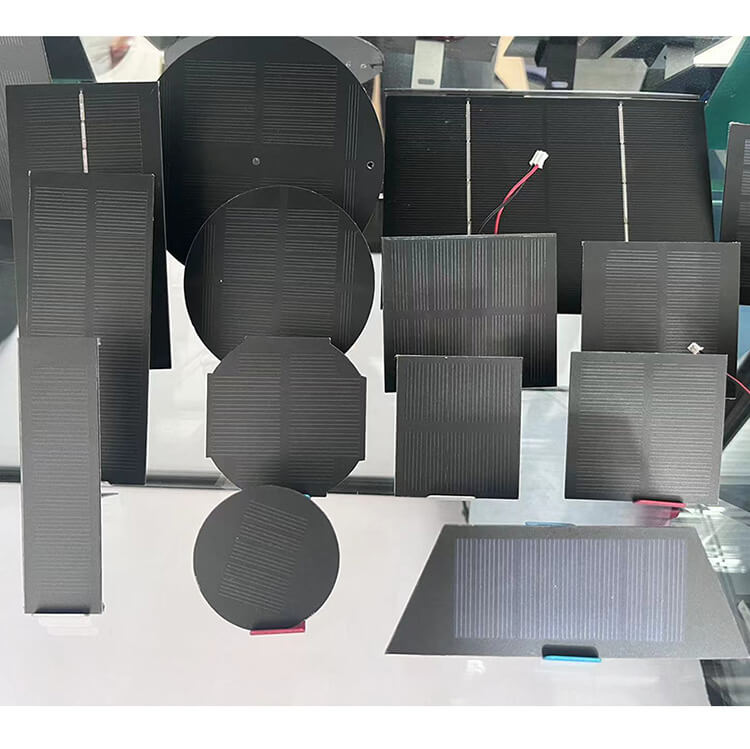
Instead of selecting only from standard panel sizes, the solar module can be designed around the available product surface and electrical requirements.
For compact applications, see our Small Solar Panels solutions.
Module Construction Comes After the Electrical Requirements
Once the required voltage, power, and available area are understood, the next question is how the solar module should be constructed.
Depending on the application, options may include:
- ETFE solar modules
- Glass solar modules
- Different solar-cell technologies
- Custom dimensions and shapes
- Adhesive mounting
- Screw mounting
- Rear cable exit
- Custom cables and connectors
For example, a compact IoT enclosure may benefit from a lightweight ETFE module that integrates directly into the product surface.
A fixed remote monitoring station may allow a rigid glass module with a more structural mounting method.
Neither construction is automatically better.
The correct choice depends on the product.
For more detail, see our ETFE vs Glass Solar Panels for Outdoor Electronics Design Guide.
This creates a natural progression:
Energy System → Electrical Requirements → Module Construction
What Information Should You Provide to a Solar Panel Manufacturer?
If you are developing a solar-powered outdoor device, providing the following information can make the initial engineering evaluation much more effective.
Device Information
✓ Operating voltage
✓ Average power consumption
✓ Peak current or peak power
✓ Daily operating profile
✓ Communication frequency, if applicable
Battery Information
✓ Battery chemistry
✓ Nominal voltage
✓ Capacity
✓ Required backup time / autonomy
Charging Information
✓ Charging controller model
✓ PV input voltage range
✓ Maximum input voltage
✓ Charging current
✓ Controller datasheet, if available
Mechanical Requirements
✓ Maximum available solar-panel dimensions
✓ Installation surface
✓ Mounting method
✓ Cable length
✓ Connector requirements
Application Environment
✓ Installation location
✓ Expected sunlight conditions
✓ Temperature range
✓ Shading conditions
✓ Moisture / water exposure
✓ Expected service life
You do not need to have every parameter finalized before contacting a solar-panel manufacturer.
For an initial evaluation, these five pieces of information are especially useful:
Device Power Consumption + Battery Information + Required Autonomy + Available Panel Area + Installation Environment
If a charging controller has already been selected, its datasheet is also very helpful.
Engineering Design Flow
A practical outdoor solar design process can be summarized in four stages.
01 — Device
Power Consumption – Daily Energy Demand
02 — Battery System
Capacity & Chemistry – Required Autonomy
03 — Charging Strategy
Charging Controller – PV Input Voltage Range
04 — Solar Panel Design
Voltage • Power • Size • Installation Environment
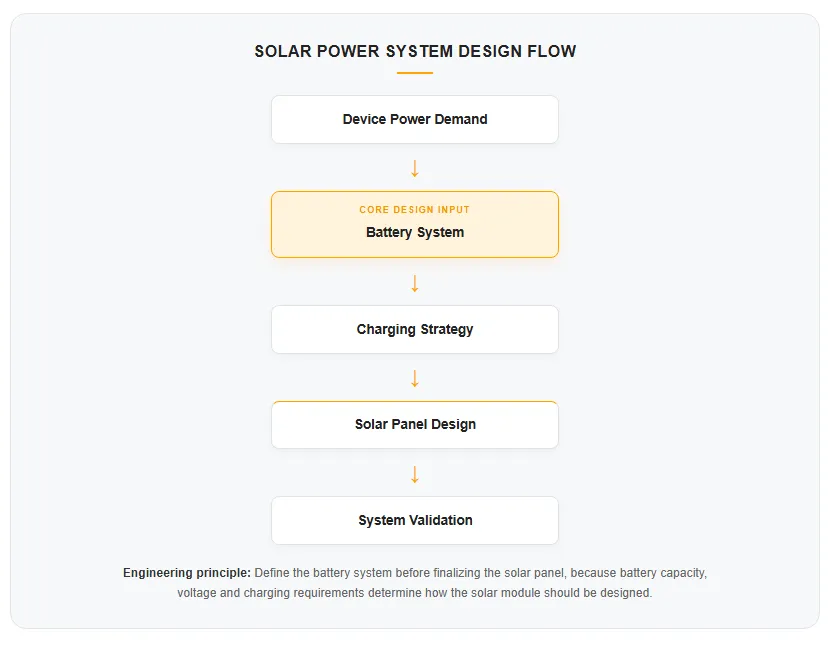
Design Takeaway: Design the Energy System First
A reliable solar-powered outdoor device does not start with selecting a solar panel.
It starts with understanding:
Device Energy Demand → Battery Capacity → Required Autonomy → Charging Strategy → Solar Panel
A larger solar panel can provide more energy, but it cannot automatically correct an undersized battery, an incompatible charging controller, excessive device consumption, or poor installation conditions.
The solar panel should therefore be the result of the system design—not the starting point.
Design the energy system first. Then design the solar panel.
Developing a Solar-Powered Outdoor Device?
XRSOLAR develops customized solar modules for IoT, remote monitoring, smart agriculture, and other outdoor electronic applications.
Depending on the project, we can customize:
- Solar-panel voltage
- Power output
- Module dimensions
- Solar-cell configuration
- ETFE or glass construction
- Cable length
- Connectors
- Mounting holes
- Adhesive backing
- Rear cable exit
For an initial engineering evaluation, send us:
Device Power Consumption + Battery Information + Controller Specifications + Available Panel Area + Installation Environment
Based on these requirements, we can evaluate the appropriate:
Voltage • Power • Dimensions • Cell Layout • Module Construction
0 Comments