
Choosing between an ETFE and a glass solar panel is not simply a question of which material is better.
Two solar panels can use similar solar cells and provide the same voltage and power output, while having very different characteristics in weight, thickness, mechanical protection, mounting method, product integration, expected service life, and manufacturing cost.
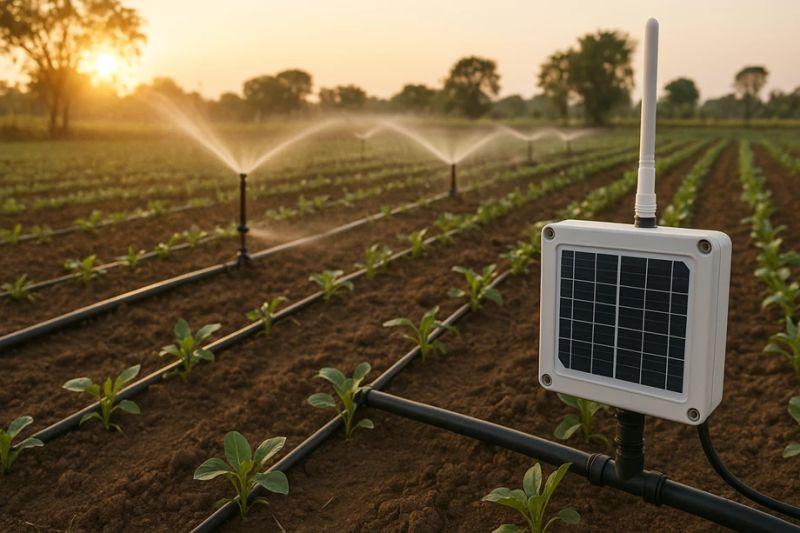
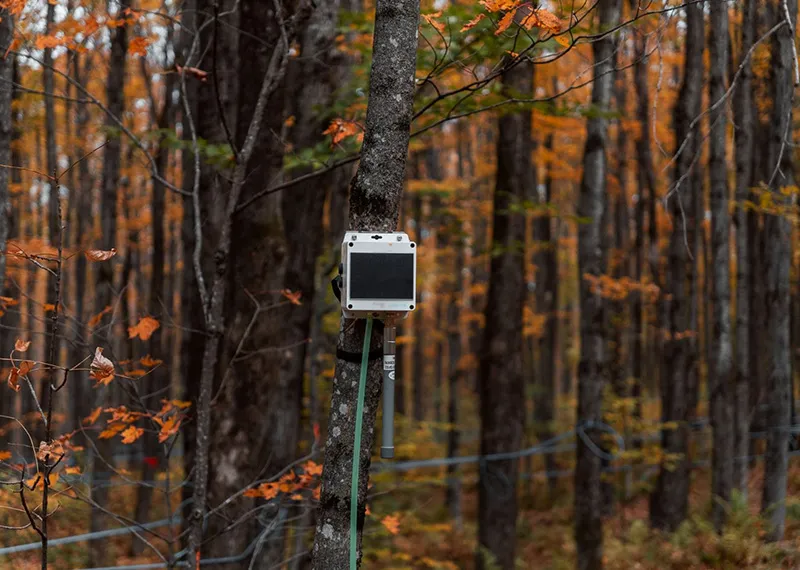
For outdoor IoT devices, smart agriculture equipment, remote monitoring systems, weather stations, GPS trackers, marine electronics, and other outdoor products, these differences can directly affect the final product design.
This guide explains how to choose between ETFE and glass solar panels from an engineering and product-integration perspective.
Start With the Application, Not the Solar Panel
One common mistake in solar-powered product development is choosing a solar panel first and then trying to make the enclosure, battery, and charging system work around it.
A better approach is to start with the complete system.
Before deciding between ETFE and glass, consider:
- Device operating voltage
- Average and peak power consumption
- Daily energy demand
- Battery voltage and capacity
- Charging requirements
- Local sunlight conditions
- Available installation area
- Mounting method
- Outdoor environment
- Expected service life
Once these requirements are clear, selecting the solar-panel construction becomes much easier.
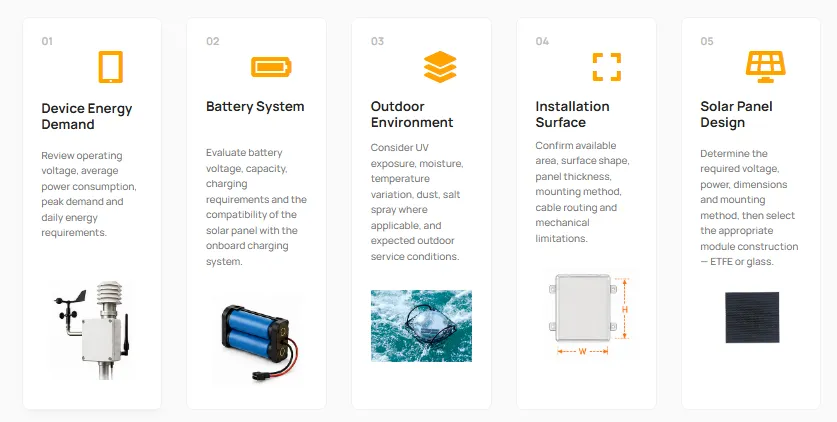
Figure 1. A practical solar module design process for outdoor electronics. Solar panel material selection should follow the electrical, environmental, and mechanical requirements of the device.
Design Note: Don’t start with “ETFE or glass?” Start with the device and its operating environment.
What Is an ETFE Solar Panel?
An ETFE solar panel uses ETFE film as the front protective surface instead of conventional solar glass.
For many small customized outdoor modules, a typical construction is:
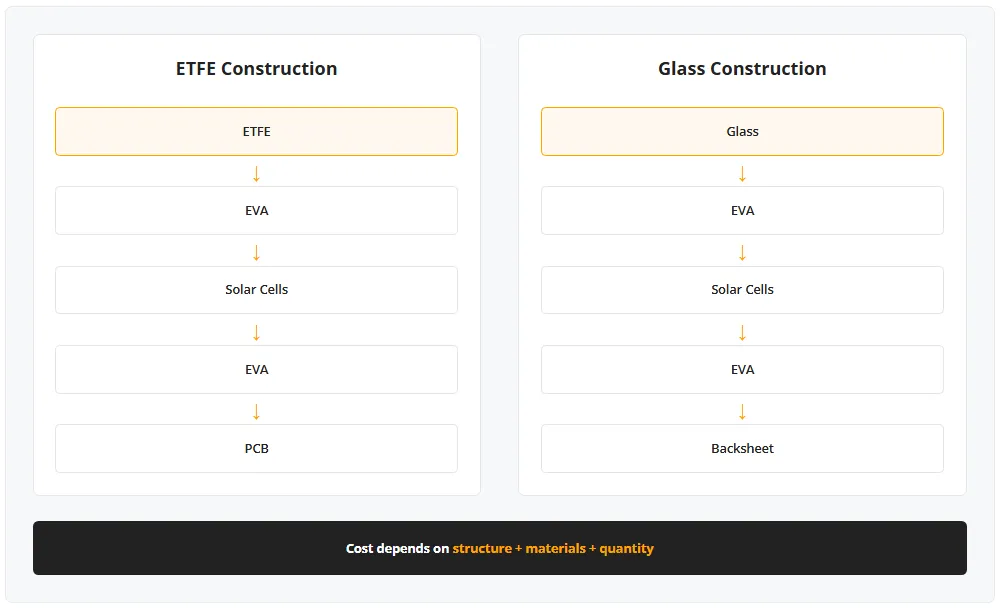
ETFE → EVA → Solar Cells → EVA → PCB
The PCB provides structural support while allowing compact electrical and mechanical integration.
This construction makes it possible to manufacture solar panels that are:
- Lightweight
- Relatively thin
- Highly customizable
- Suitable for compact products
- Easy to integrate into electronic enclosures
ETFE modules can also be customized in:
- Size and shape
- Voltage and power
- Solar cell layout
- Cable length
- Connector
- Mounting holes
- Adhesive backing
- Rear cable exit
This makes ETFE particularly useful when the solar panel needs to become part of the product itself, rather than a separate external PV component.
Typical Applications
ETFE solar panels are commonly considered for:
- Outdoor IoT devices
- Environmental sensors
- GPS and tracking equipment
- Smart agriculture devices
- Remote monitoring systems
- Small marine electronics
- Portable outdoor equipment
- Solar-powered battery devices
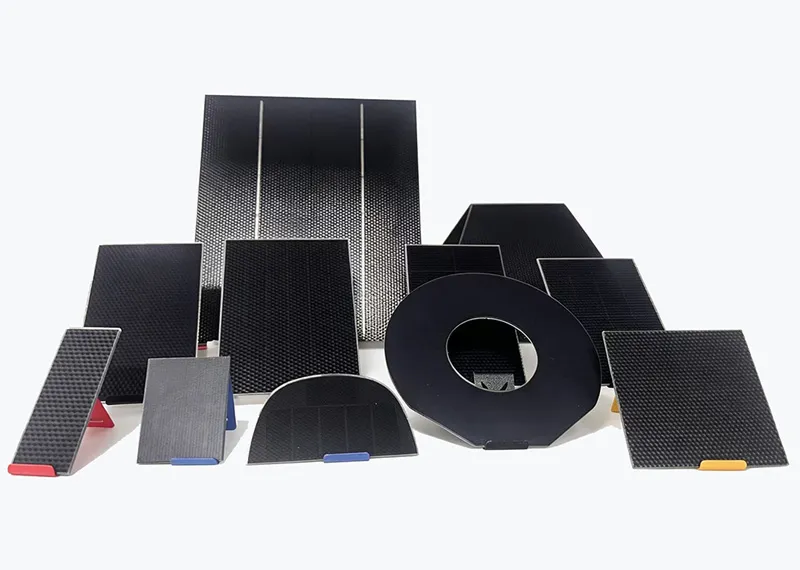
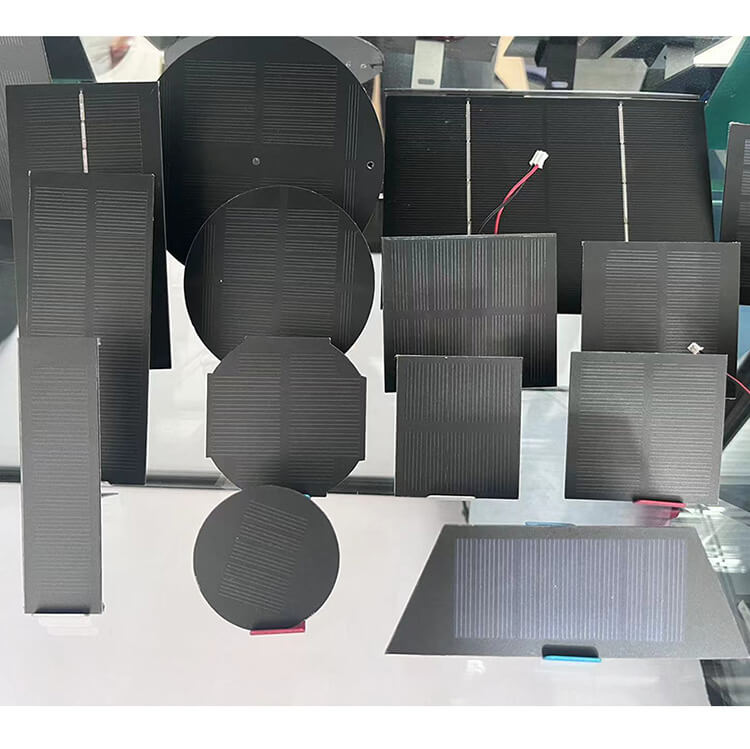
Use a real XRSOLAR product photo showing several customized ETFE modules in different sizes or shapes.
Caption:
Customized ETFE solar panels can be designed around the available surface, electrical requirements, and mounting structure of outdoor electronic devices.
What Is a Glass Solar Panel?
Glass solar panels use solar glass as the front protective layer.
A typical customized small glass module may use:
Glass → EVA → Solar Cells → EVA → Backsheet
Depending on the application and module size, the panel can be manufactured with or without an aluminum frame.
Compared with lightweight ETFE construction, glass provides a rigid front surface and is often considered for fixed outdoor installations where additional weight and thickness are acceptable.
Typical Applications
Customized glass solar panels can be suitable for:
- Permanent outdoor monitoring stations
- Industrial equipment
- Weather stations
- Remote infrastructure
- Security equipment
- Solar lighting systems
- Marine installations
- Outdoor control systems
Glass becomes particularly interesting when weight and thickness are less important than rigidity, mechanical protection, and long-term outdoor installation.
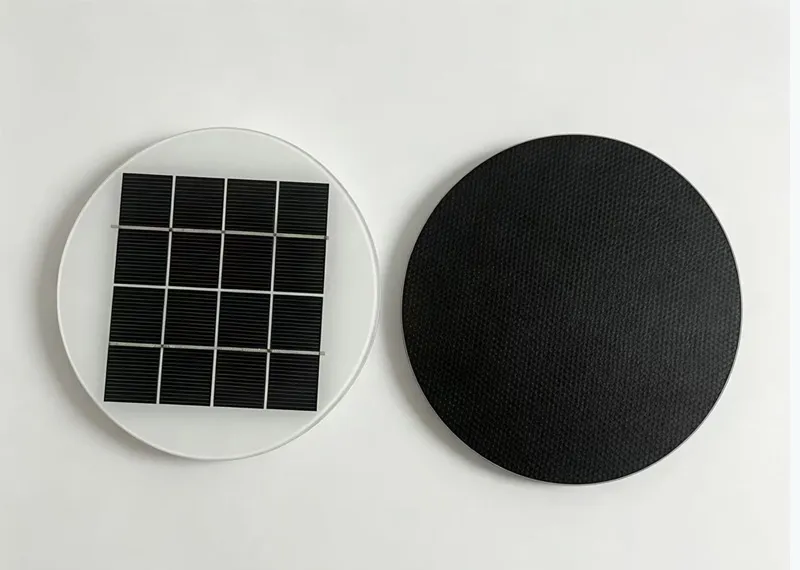
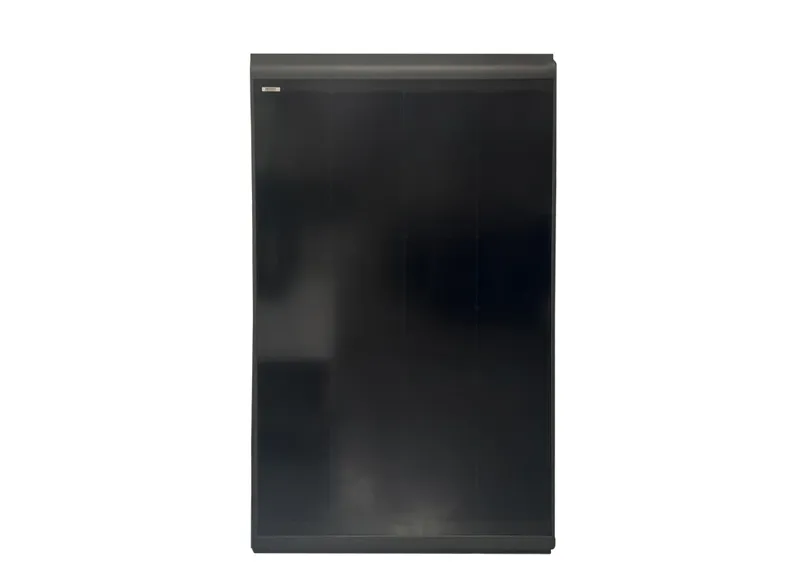
Use real XRSOLAR framed and frameless glass solar panel photos.
Caption:
Framed and frameless glass solar modules provide different mounting options for fixed outdoor equipment.
ETFE vs Glass Solar Panels: Key Differences
The most important differences between ETFE and glass modules are not necessarily electrical.
They are often mechanical and application-related.
| Design Factor | ETFE + PCB | Glass |
|---|---|---|
| Weight | Lightweight | Heavier |
| Thickness | Thin construction possible | Generally thicker |
| Rigidity | Depends on PCB structure | High |
| Surface protection | Suitable for many outdoor electronics | Strong rigid surface |
| Glass breakage risk | No glass shattering | Possible under severe impact |
| Custom shapes | Excellent | More restricted |
| Small-size customization | Excellent | Good |
| Adhesive integration | Excellent | Application dependent |
| Screw/bracket mounting | Possible | Excellent |
| Enclosure integration | Excellent | Good |
| Long-term fixed installation | Application dependent | Strong candidate |
| Current material cost | PCB pricing has significant influence | Can be competitive |
| Typical design fit | Compact integrated electronics | Fixed outdoor equipment |
This comparison should only be used as a starting point.
Neither construction is automatically better.
The correct choice depends on the complete product.
Cost Comparison: Glass Is Not Always More Expensive
Cost is another factor that product teams should evaluate carefully.
It is sometimes assumed that a small glass solar module will automatically cost more than an ETFE module.
That assumption does not always hold.
Manufacturing Note — Updated September 2026
During the second half of 2026, we have seen significant increases in the cost of some raw materials used in customized ETFE modules.
One important change has been the increase in PCB material cost.
Many customized ETFE modules use a structure such as:
ETFE → EVA → Solar Cells → EVA → PCB
In this construction, the PCB is not simply an electrical component. It also provides mechanical support and represents an important part of the module’s material cost.
As PCB prices increase, the cost difference between PCB-based ETFE modules and customized glass modules can become smaller.
For some projects we are currently evaluating, glass construction can offer a cost advantage compared with an ETFE + PCB module with similar electrical requirements.
This is particularly worth considering when:
- Weight is not a critical constraint
- A very thin module is not required
- The installation is fixed
- A rigid module can be integrated easily
- Long-term outdoor installation is expected
Don’t Select ETFE Based on Cost Alone
If both ETFE and glass can satisfy the mechanical requirements of a device, it is worth evaluating both constructions during the design and quotation stage.
The question should not simply be:
Which material is cheaper?
A better engineering question is:
Which construction provides the required performance at the most practical total cost for this product?
Raw-material prices change, and every product has different mechanical and electrical requirements.
The most economical construction should therefore be evaluated project by project.
When Should You Choose ETFE?
ETFE should be considered when weight, thickness, customization, and product integration are important design priorities.
Weight Matters
Portable equipment, pole-mounted sensors, GPS devices, compact enclosures, and lightweight outdoor electronics can benefit from a lower module weight.
Installation Space Is Limited
Small electronic devices often provide only a limited area for solar-cell placement.
ETFE construction offers greater flexibility when designing around constrained dimensions.
The Panel Must Integrate Into the Enclosure
Depending on the project, ETFE modules can support different installation methods, including:
- 3M adhesive
- Structural adhesive
- Mounting holes
- PCB-based integration
- Rear cable exit
The solar module can therefore function more like a component of the electronic product than a conventional external solar panel.
Custom Dimensions or Shapes Are Required
The available installation surface is not always a standard rectangle.
Depending on solar-cell layout and manufacturing constraints, customized dimensions and shapes can help use the available surface more efficiently.
When Should You Choose Glass?
Glass should be considered when rigidity, long-term fixed installation, and mechanical protection are higher priorities than weight.
The Equipment Will Remain Outdoors Continuously
Permanent monitoring stations and industrial systems may benefit from a rigid glass construction.
Weight Is Not a Major Constraint
If the solar module is mounted on a fixed enclosure, pole, bracket, or other structure, additional weight may have relatively little impact on the complete system.
A Rigid Protective Surface Is Required
Glass provides a rigid front surface that helps protect the solar cells from direct mechanical contact.
Framed Installation Is Preferred
For larger customized modules, an aluminum frame can simplify mechanical installation and provide additional structural support.
Cost Is an Important Design Constraint
Under current raw-material conditions, glass should also be evaluated when both constructions are technically feasible.
For some projects, it may provide a more economical solution than PCB-based ETFE construction.
Mounting Method Can Decide the Material
Mounting is one of the most overlooked factors when comparing ETFE and glass solar panels.
Consider two outdoor devices that both require:
5V / 2W solar input
Electrically, their requirements may look almost identical.
Mechanically, however, they can be completely different.
Device A — Compact Agricultural Sensor
Imagine a small soil-monitoring device with a plastic enclosure.
The design requires:
- Low weight
- Limited installation area
- No external bracket
- Integrated appearance
An ETFE module bonded directly to the enclosure may help reduce:
- Brackets
- Fasteners
- Weight
- Assembly complexity
Device B — Permanent Remote Monitoring Station
Now consider a monitoring station installed on a steel pole.
The design requires:
- Fixed installation
- Continuous outdoor exposure
- Less sensitivity to weight
- Structural mounting
In this case, a rigid glass module installed with screws or brackets may be more appropriate.
The electrical specification may be identical.
The correct module construction is not.
Design Note: Mounting method should be considered at the same time as solar-panel material — not after the panel has already been selected.
Outdoor Protection Depends on More Than the Front Material
It is easy to simplify the comparison to:
Glass = waterproof
or:
ETFE = waterproof
But real outdoor reliability depends on the complete module construction, not only the front material.
Engineers should also evaluate:
- Edge sealing
- Lamination quality
- Cable exit
- Junction area
- Connector protection
- Mounting holes
- Adhesive system
- Enclosure interface
- Water accumulation
- UV exposure
- Temperature cycling
For example, a durable front surface provides little benefit if water can enter through an inadequately protected cable exit or enclosure interface.
For outdoor electronics, the solar module and product enclosure should therefore be considered as one environmental protection system.
Don’t Forget Solar Cell Selection
ETFE or glass defines only part of the solar module.
Solar-cell technology also affects:
- Efficiency
- Available power
- Required surface area
- Cell layout
- Appearance
- Cost
For compact outdoor electronics, efficiency can become especially important because the available installation area is often fixed.
If a device enclosure provides only a limited surface, changing the solar-cell technology may allow more power to be generated within the same available area.
However, the design objective should not automatically be:
Use the highest-efficiency solar cell available.
A more practical question is:
How much usable solar power can we reliably generate within the available product area and project budget?
Cell technology, module construction, and product architecture should therefore be considered together.
Example: Designing a Solar Module for a Remote Sensor
Consider a hypothetical outdoor monitoring device.
Application: Remote environmental sensor
Battery: 3.7V rechargeable battery
Installation: Pole mounted outdoors
Available Solar Area: Limited by the enclosure
Maintenance: Difficult and expensive
Should the engineer immediately choose ETFE or glass?
No.
The process should start with the power system.
Step 1 — Calculate Device Energy Consumption
Evaluate:
- Sensor operation
- Data transmission
- Standby consumption
- Peak loads
- Daily energy consumption
Step 2 — Define Battery Requirements
Determine how long the device should continue operating during periods of poor sunlight.
Battery capacity should provide sufficient autonomy without making the complete system unnecessarily large.
Step 3 — Calculate Required Solar Input
Consider:
- Charging losses
- Local solar conditions
- Installation angle
- Seasonal variation
- Safety margin
Step 4 — Check Available Solar Area
Determine whether the required solar power can physically fit within the available enclosure surface.
If not, the engineer may need to reconsider:
- Solar-cell efficiency
- Device power consumption
- Battery capacity
- Installation area
- Charging strategy
Step 5 — Compare ETFE and Glass
Only now does material selection become the right question.
For ETFE, consider:
- Is low weight important?
- Does the module need to bond directly to the enclosure?
- Is a custom dimension or shape required?
For glass, consider:
- Can the structure support additional weight?
- Would rigid mounting improve long-term reliability?
- Is a fixed installation planned?
- Does glass currently provide a cost advantage?
The final decision should consider both the electrical system and mechanical product design.
ETFE or Glass? Quick Selection Checklist
For engineers in the early design stage, the following checklist can provide a useful starting point.
Consider ETFE If:
✓ Low weight is important
✓ Thin construction is required
✓ Installation area is limited
✓ Custom dimensions are required
✓ Custom shapes may be needed
✓ The module should integrate into the enclosure
✓ Adhesive mounting is preferred
Consider Glass If:
✓ Installation is permanent
✓ Weight is less important
✓ High rigidity is required
✓ Long outdoor service is a priority
✓ Screw or bracket mounting is acceptable
✓ A framed construction is preferred
✓ Current project cost is an important consideration
Compare Both If:
✓ Either construction can satisfy the mechanical requirements
✓ Project volume is significant
✓ Cost optimization is important
✓ The product is still in the prototype or validation stage
If the product can accept either construction, compare ETFE and glass before freezing the mechanical design.
This gives the engineering and purchasing teams more flexibility to balance performance, manufacturing cost, and long-term reliability.
Design Takeaway: Let the Application Decide the Solar Panel
There is no universal winner between ETFE and glass solar panels.
The right choice depends on the complete product design.
A reliable design process starts with the power system and installation requirements before moving to material selection.
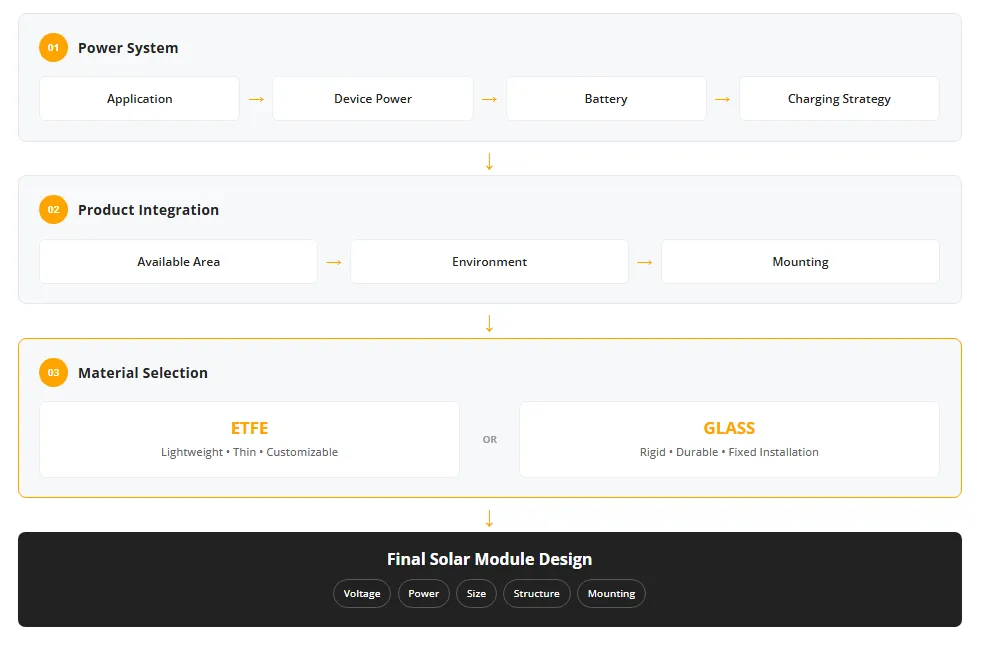
The solar panel material should be the result of the design process — not the starting point.
Need Help Choosing Between ETFE and Glass?
XRSOLAR develops customized solar modules for outdoor electronic and industrial applications.
We can support customization of:
- Panel dimensions and shape
- Voltage and power
- ETFE or glass construction
- Solar-cell technology
- Cable length
- Connector
- Mounting holes
- Adhesive backing
- Rear cable exit
- OEM labeling
You don’t need to have a complete solar-panel specification before contacting us.
For an initial engineering evaluation, send us:
Application + Available Area + Battery Information + Device Power Consumption + Installation Environment
Our engineering team can use these requirements as the starting point for your custom solar module design.
0 Comments