
When developing a solar-powered outdoor device, one of the first specifications customers often provide is:
“We need a 5V solar panel.”
But 5V alone is usually not enough information to design the right solar module.
The more important questions are:
- What battery is being charged?
- What charging controller is being used?
- What solar input voltage range does the controller accept?
- What are the device’s power requirements?
- How much area is available for the solar panel?
In many outdoor electronic systems, the solar panel does not connect directly to the battery.
Instead, the power path looks more like this:
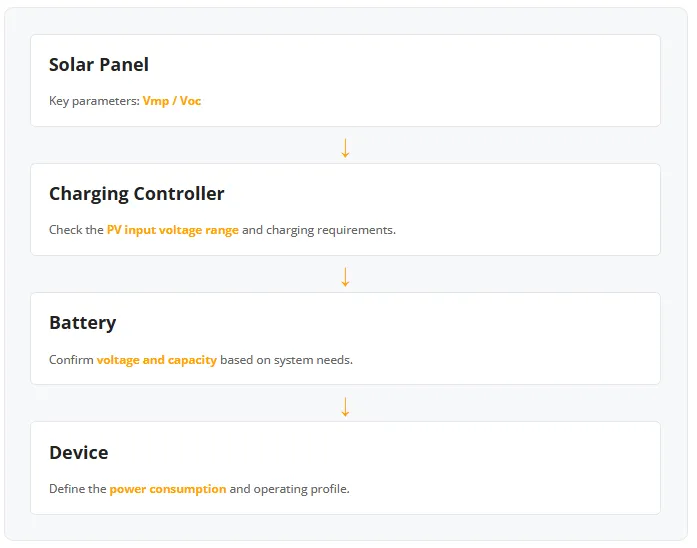
Solar Panel → Charging Controller → Battery → Device
This means solar-panel voltage should be selected as part of the complete power system, rather than as an isolated specification.
Start With the Battery, Not the Solar Panel
The battery is a good starting point for solar module design.Before selecting the solar-panel voltage, we normally need to understand:
- Battery chemistry
- Nominal battery voltage
- Battery capacity
- Charging voltage
- Charging current
- Required operating autonomy
For example, an outdoor sensor may use a 3.7V lithium-ion battery.
This does not automatically mean it should use a 3.7V, 5V, or 6V solar panel.
The correct solar-panel specification depends on how that battery is being charged.
A similar situation applies to 6V, 12V, and 24V battery systems.
The battery tells us where the power needs to go.
The charging system helps determine what the solar panel needs to deliver.
Engineering Note: Battery voltage is the starting point—not the complete solar-panel specification.
I recommend adding a simple engineering diagram here:
Why Battery Voltage Alone Is Not Enough
Consider two outdoor devices.
Both use:
3.7V lithium-ion batteries
At first glance, it might seem reasonable to use the same solar-panel voltage for both products.
But their charging electronics may be different.
For example:
Device A
Battery: 3.7V Li-ion
Controller PV Input: 5–6V
Device B
Battery: 3.7V Li-ion
Controller PV Input: 6–12V
The batteries are the same.
The acceptable solar input voltage is not.
This is why we normally recommend checking the charging controller specification before finalizing a customized solar panel.
The battery defines the energy-storage system.
The controller defines how solar energy can enter that system.
The Controller Input Voltage Range Matters
For many outdoor electronics, the charging controller or power-management circuit is one of the most important factors in solar-panel voltage selection.
Depending on the product, the system may use:
- A solar charging IC
- DC-DC charging circuit
- PWM controller
- MPPT controller
- Integrated power-management board
- Customer-designed charging circuit
Each controller can have its own input requirements.
Before designing the solar module, it is useful to know:
- Recommended PV input voltage range
- Maximum permitted input voltage
- Minimum operating voltage
- Startup voltage, if specified
- Maximum input current
- Charging current requirements
For example, if the controller specification states:
Solar / PV Input: 6–10V
the solar module should be designed so that its relevant operating characteristics are compatible with that input requirement.
Simply saying:
“The battery is 3.7V.”
does not provide enough information.
What Should You Send to the Solar Panel Manufacturer?
If available, provide:
Controller model + Controller datasheet + PV input voltage range
If the charging circuit is custom-designed, the relevant electrical specifications or schematic information can also be useful.
With this information, the solar-panel manufacturer can evaluate the required:
Vmp + Voc + Cell Configuration + Power
instead of selecting a voltage based only on the battery’s nominal voltage.
Engineering Note: The battery tells us where to start. The controller’s solar input requirements help determine what the solar panel must deliver.
Understand Vmp and Voc
Another common source of confusion is the difference between Vmp and Voc.
They are not the same specification.
Vmp — Voltage at Maximum Power
Vmp is the voltage at which the solar panel produces maximum power under specified test conditions.
It is closely related to how the module operates when connected to a load or charging system.
Voc — Open-Circuit Voltage
Voc is the voltage measured when the solar panel is not connected to a load.
Because there is no load, Voc is normally higher than Vmp.
This means a solar panel described as a “6V panel” does not necessarily output exactly 6.00V under every operating condition.
A simplified example might look like:
Rated Voltage: 6V
Vmp: 6.0V
Voc: 7.2V
The exact values depend on the solar-cell configuration and module design.
This distinction becomes particularly important when the controller has a maximum input voltage limit.
Both operating voltage and open-circuit voltage need to be considered during system design.
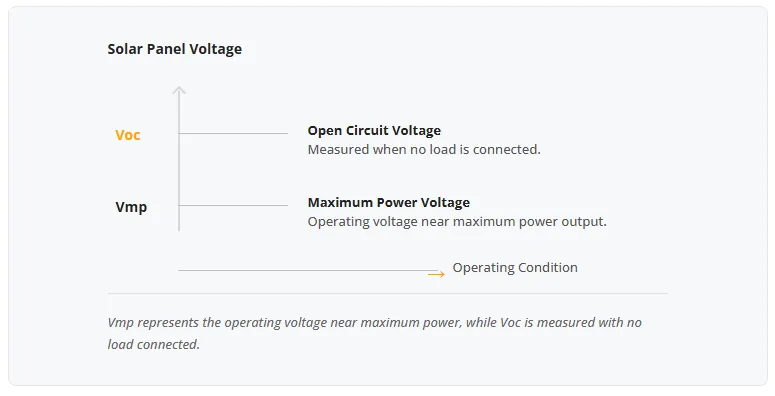
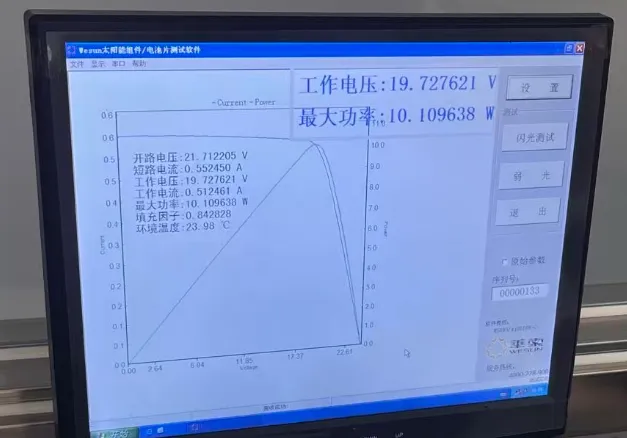
Image: 10W ETFE Solar Panel IV Test
More Solar Panel Voltage Is Not Always Better
Another assumption we sometimes encounter is:
“If the voltage is higher, the battery will charge better.”
Not necessarily.
Using a solar-panel voltage that is unnecessarily high may create other design problems.
Depending on the charging electronics, excessive input voltage can:
- Exceed the controller’s permitted input range
- Require additional voltage conversion
- Increase conversion losses
- Affect charging efficiency
- Require a different cell configuration
- Affect the available panel dimensions
- Increase system complexity
The design target should therefore not be:
The highest possible solar-panel voltage
It should be:
An appropriate voltage range for the complete charging system.
This is another reason why the controller specification should be confirmed before the solar-panel design is finalized.
Solar Panel Voltage Is Not Constant Outdoors
Even after the correct Vmp and Voc targets have been defined, real outdoor conditions still need to be considered.
Solar-panel electrical performance is affected by operating conditions such as:
- Solar irradiance
- Cell temperature
- Partial shading
- Installation angle
- Seasonal variation
- Dirt or surface contamination
- Device orientation
A specification measured under standard test conditions should not be interpreted as a voltage that remains perfectly constant throughout the day.
For example, lower irradiance can reduce the available current and power, while temperature can also affect module voltage.
This is why the complete charging system should have an appropriate operating margin rather than relying on one exact voltage value.
For outdoor electronics, panel voltage, available power, battery capacity, and charging strategy should be considered together.
Voltage Is Only Half of the Question
Matching the voltage does not automatically mean the solar panel is large enough for the application.
Consider a solar module with the correct voltage for the controller.
If it cannot generate enough energy during the available sunlight hours, the battery may still gradually discharge.
This is why solar-panel design must consider both:
Voltage
Is the module electrically compatible with the charging controller?
Power
Can the module generate enough daily energy for the device?
The required power depends on factors such as:
- Average device consumption
- Peak power demand
- Operating duty cycle
- Communication frequency
- Battery capacity
- Required autonomy
- Available sunlight
- Charging losses
For remote sensors and IoT devices, this distinction is particularly important.
A device may consume very little power most of the time but have significantly higher peak consumption during wireless transmission.
The solar system needs to support the complete energy profile, not just the nominal device voltage.
A Practical Example: Outdoor IoT Sensor
Consider a simplified outdoor monitoring device.
System Requirements
Application: Remote IoT sensor
Battery: 3.7V Li-ion
Installation: Outdoors
Available Area: Limited by enclosure
Maintenance: Difficult
Power Source: Solar charging
Should we immediately design a 5V or 6V solar panel?
No.
A more reliable process is:
Step 1 — Understand Device Consumption
Confirm:
- Operating voltage
- Average power consumption
- Peak current
- Standby consumption
- Communication frequency
- Daily energy requirement
Step 2 — Confirm the Battery
Check:
- Battery chemistry
- Nominal voltage
- Capacity
- Charging requirements
- Required backup time
Step 3 — Check the Charging Controller
This is critical.
Confirm:
- Controller model
- PV input voltage range
- Maximum input voltage
- Charging current requirements
If the customer can provide the controller datasheet, the solar-panel electrical design can be evaluated more accurately.
Step 4 — Define the Required Solar Input
Now the appropriate Vmp, Voc, and power range can be evaluated.
Step 5 — Check the Available Area
Finally, determine whether the required solar-cell configuration can fit within the available product dimensions.
If it cannot, the engineering team may need to reconsider:
- Cell efficiency
- Panel dimensions
- Device power consumption
- Battery capacity
- Charging strategy
- Installation position
This is why custom solar-module development should be treated as a system design problem, rather than simply selecting a voltage from a product list.
What Information Should You Provide for a Custom Solar Panel?
When requesting a customized solar module for an outdoor electronic device, providing the following information can significantly improve the design process.
Electrical Requirements
✓ Device operating voltage
✓ Average power consumption
✓ Peak current or peak power
✓ Daily energy consumption, if known
Battery Information
✓ Battery chemistry
✓ Nominal voltage
✓ Capacity
✓ Charging requirements
Charging Controller
✓ Controller or charging IC model
✓ Solar / PV input voltage range
✓ Maximum permitted input voltage
✓ Charging current
✓ Controller datasheet, if available
Mechanical Requirements
✓ Maximum available panel dimensions
✓ Installation surface
✓ Mounting method
✓ Cable length
✓ Connector requirements
Once the electrical requirements are defined, the next step is selecting the appropriate module construction. See our ETFE vs Glass Solar Panels for Outdoor Electronics Design Guide.
Application Environment
✓ Indoor or outdoor
✓ Installation location
✓ Expected sunlight conditions
✓ Temperature range
✓ Water / moisture exposure
✓ Expected service life
You do not necessarily need to know every parameter before contacting a solar-panel manufacturer.
But one piece of information is particularly useful:
If your product already has a charging controller, please provide its solar / PV input voltage range.
This can prevent the solar module from being designed around an incorrect voltage assumption.
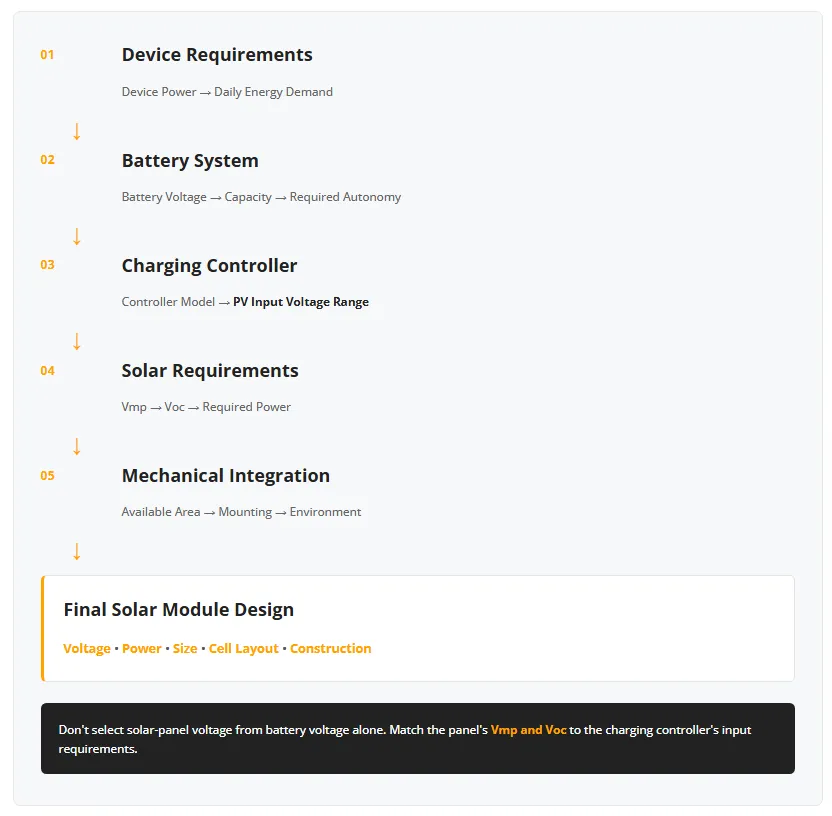
Engineering Takeaway: Design Around the Complete Power System
Choosing the correct solar-panel voltage is not simply a matter of matching the battery’s nominal voltage.
The more reliable design sequence is:
Developing a Solar-Powered Outdoor Device?
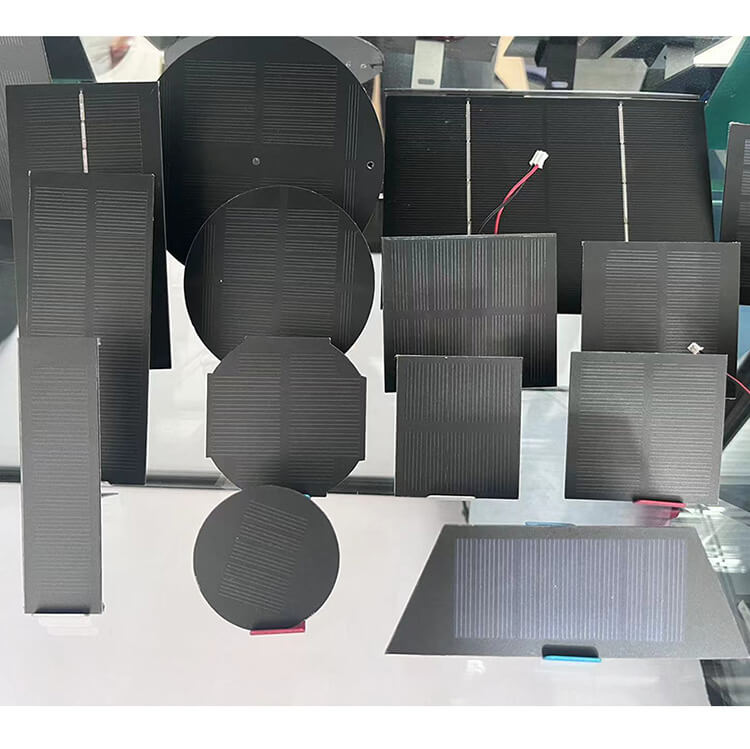
XRSOLAR develops customized solar modules based on the electrical and mechanical requirements of the complete device.
Depending on the project, we can customize:
- Solar-panel voltage
- Power output
- Dimensions
- Cell configuration
- ETFE or glass construction
- Cable length
- Connector
- Mounting holes
- Adhesive backing
- Rear cable exit
For an initial engineering evaluation, send us:
Device Power + Battery Information + Controller PV Input Range + Available Panel Area + Application Environment
We can then evaluate the appropriate solar-panel voltage, power, dimensions, and construction for your application.
0 Comments